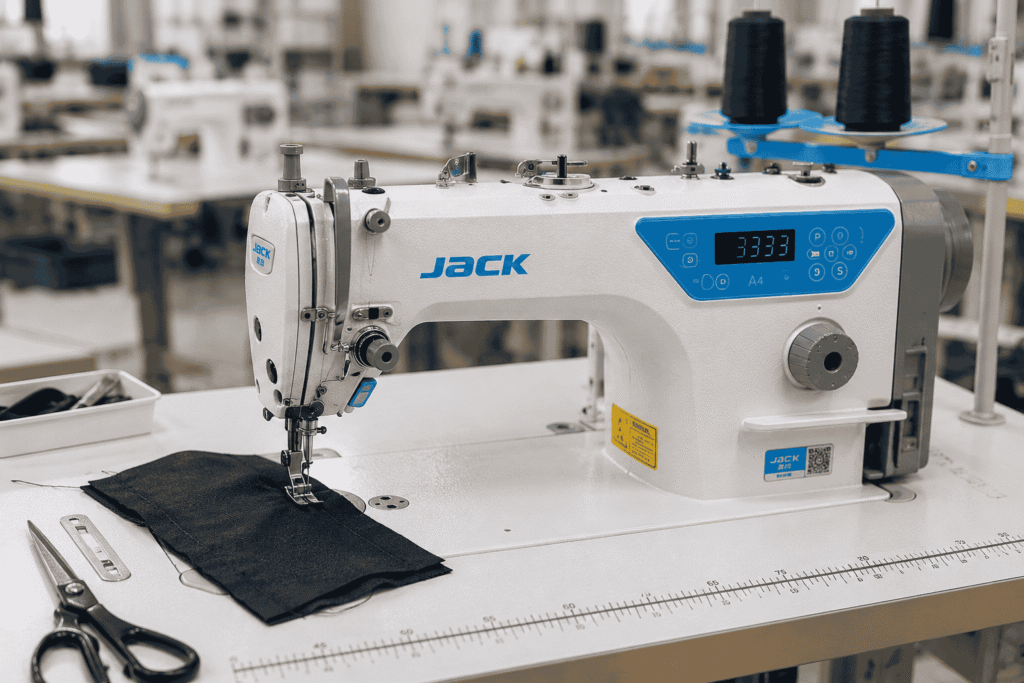
The selection of the right sewing machine by industrial users such as garment makers, tailors, textile industries, among others is vital for the proper operation of the business. The Jack sewing machine comes in various forms which are lock-stitch sewing machine, over-lock, inter-lock, heavy-duty, and specialized machines.
Some of the popular Jack sewing machines include F4, F5, A4B, A6F, and E4S machines. However, the right machine will depend on the fabric, kind of stitch, production rate and the application. It is vital to note that Jack has developed new series of machines hence the need to refer to the specifications.
Quick Answer: Which Jack Sewing Machine Should You Choose?
General sewing of clothing items will generally begin with a Jack lockstitch sewing machine. For seam and edge finishing, an overlock sewing machine would be more suitable. Interlock sewing machines may be required for knitwear or special sewing jobs, whereas heavy-duty sewing machines will be needed for thick fabrics or multi-layer sewing.
A good Jack sewing machine will depend on:
- Fabric type and thickness
- Type of sewing or stitch needed
- Quantity of output per day
- Manual or automatic operations
- Sewing speed
- Automation
- Available space
- Availability of spare parts
- Technical support and after sales services
Popular Jack Sewing Machine Models
Jack produces industrial sewing machines for different garment and textile applications. The following models are commonly considered when selecting equipment for industrial sewing operations.
Jack F4 Sewing Machine
The Jack F4 lockstitch sewing machine is a general-purpose lockstitch sewing machine that works at high speeds. The F4 sewing machine will be useful to firms that need efficient straight stitching on their clothing items.
The F4 sewing machine is applicable in cases where a lockstitch flat-bed sewing machine is required. The customer should consider comparing his needs with the specifications of the F4 sewing machine.
Jack F5 Sewing Machine
The Jack F5 sewing machine is a direct-drive lockstitch machine designed for industrial garment sewing. Jack’s published F5 documentation lists features including a bobbin winder, LED lighting, thread cutter and speed adjustment. The standard F5 configuration listed by Jack has a maximum speed of 5,000 stitches per minute, while other F5 variants are specified for different material ranges and stitch lengths.
This makes the F5 a practical option to consider for general production sewing where speed, direct drive and convenient operation are important.
Jack A4B Sewing Machine
The Jack A4B sewing machine is a computerized lockstitch model designed to provide greater control over sewing operations. Jack’s published specifications include digital controls, adjustable stitch settings and electronic functions depending on the specific A4B configuration. Some variants support light and medium materials, while other versions are specified for heavier materials.
The A4B can therefore be considered by garment businesses that need more automation and control than a basic industrial lockstitch machine.
Jack A6F Sewing Machine
Jack A6F is a computerized lockstitch machine that incorporates the advanced digital needle feed mechanism. According to the manufacturer’s A6F-E model specifications, the maximum speed capacity of this standard A6F-E configuration is 4,000 stitches per minute while the maximum speed capacity of its heavy material A6F-EH configuration is 3,000 stitches per minute.
Other aspects about the A6F-E model described by the manufacturer are its large operating area and uses such as down jackets, cotton jackets, curtains, bed sheets and duvet covers.
Since different A6F models exist, it is recommended to verify your choice before purchasing one.
Jack E4S Overlock Machine
The Jack E4S is an industrial overlock sewing machine for seam finishing. Various E4S models can be selected based on specific sewing needs.
Some models of the E4S series from Jack include those for plain sewing, back-latching, light fabrics, denim fabrics, and heavy-duty sewing. Some of the models have maximum speeds of up to 5,500 stitches per minute.
Therefore, the E4S series can be applied by clothing manufacturers or tailors who need quality seam finishing.
Jack Sewing Machine Models Comparison
Jack model | Machine type | Main application | Automation / control |
Jack F4 | Lockstitch | General industrial stitching | Depends on configuration |
Jack F5 | Lockstitch | General garment production | Direct drive and electronic features |
Jack A4B | Computerized lockstitch | Controlled garment production | Computerized |
Jack A6F | Computerized lockstitch | Garments and selected heavier applications | Digital needle feed |
Jack E4S | Overlock | Seam and edge finishing | Depends on configuration |
Note: Jack offers multiple configurations within several model families. Specifications such as maximum speed, needle type, material suitability and stitch length can differ by suffix. Always verify the exact model before purchasing.
Types of Jack Sewing Machines
Different production processes require different sewing machines. Jack’s range covers several industrial sewing categories.
Lockstitch Sewing Machines
Lockstitch sewing machines create a straight, stable stitch using upper and bobbin thread. They are widely used for general garment construction, including applications such as shirts, trousers, uniforms and other woven garments.
Lockstitch machines are often considered when a business needs a reliable machine for straight seams and general production sewing.
Overlock Sewing Machines
The overlock sewing machines is commonly employed for stitching edges and seam creation. It can simultaneously cut and create an overlocking stitch.
This type of sewing machine is very beneficial in the manufacture of clothing where there is a need to create strong and neat stitches.
Interlock Sewing Machines
Interlock sewing machines are employed for specialized sewing operations such as knitting and cover seam sewing. Such sewing machines could work perfectly well for T-shirts and sports wear among others, which require specific sewing and hemming operations.
This depends entirely on the material and sewing to be done.
Heavy-Duty Sewing Machines
Heavy duty sewing machines are meant for use where there are thick materials and tough working conditions.
The material can include denim, leather, canvas or any other heavy duty material depending on the specification of the sewing machine. Heavy duty sewing machines that have been listed by Narula Sewing Impex include Jack’s H2, H5K and H6. Other uses that can include the use of heavy duty sewing machines include upholstery, furniture sewing, bag manufacturing and industrial textiles among others.
Zig-Zag Sewing Machines
A zig-zag sewing machine is one that makes stitches from side to side instead of a straight lockstitch. It can be used in decoration, reinforcement, and other specific industrial sewing work.
The machine should be chosen based on the type of stitch and material involved.
Which Jack Sewing Machine Is Best for Different Applications?
There is no single Jack sewing machine that is best for every business. The correct model depends on what you need to sew.
Application | Machine type to consider |
General garment stitching | Lockstitch |
Straight seams | Lockstitch |
Edge finishing | Overlock |
Knitwear production | Interlock / Overlock |
T-shirt production | Interlock / Overlock |
Heavy fabrics | Heavy-duty |
Denim applications | Suitable heavy-material configuration |
Upholstery work | Heavy-duty configuration |
Decorative zig-zag stitching | Zig-zag |
These are general application categories rather than universal rules. Fabric thickness, seam construction, thread, needle and the exact machine configuration should always be considered before purchasing.
Jack F4 vs F5: Which One Should You Choose?
Both the Jack F4 and F5 belong to the industrial lockstitch category, so the decision should not be based on the model name alone.
Consider:
- Required sewing speed
- Fabric type
- Stitch length
- Motor and drive configuration
- Thread-cutting requirements
- Production volume
- Operator preferences
- Availability of service and spare parts
Jack’s published F5 specifications list a maximum speed of 5,000 stitches per minute for the standard F5, while variants have different material and stitch-length specifications.
For the F4, buyers should likewise verify the exact configuration rather than assuming that every F4 machine has identical specifications.
Jack A4B vs A6F
The A4B and A6F are both more advanced than a basic industrial lockstitch machine, but they are designed with different functions and configurations.
The A4B provides computerized control and digital functions, with Jack documentation listing features such as electronic controls and adjustable stitch settings.
The A6F uses digital needle-feed technology, and Jack lists configurations for light, medium and heavier materials.
The better choice depends on the sewing process, fabric, production requirements and features needed by the operator.
How Much Does a Jack Sewing Machine Cost in India?
The cost of a Jack sewing machine in India differs depending on the type of machine, configuration, level of automation, engine, accessories, capability of the material and vendor.
An ordinary industrial lockstitch machine will not cost the same as a computerized machine, overlock machine, interlock machine or heavy duty machine.
Rather than picking a machine just based on its cost, compare:
- Machine specifications
- Application
- Engine used
- Level of automation
- Max. Sewing speed
- Material capability
- Warranty
- Availability of spare parts
- Installation/technical support
- After sales support
To get the latest quotation, buyers should obtain the quotation of the machine they need.
What Should You Check Before Buying a Jack Sewing Machine?
Answer the following before buying:
1. What kind of fabric would you be sewing on?
Will you be working on light fabrics, medium fabrics, denim, leather, canvas, knits, or more than one type?
2. What kind of stitching do you require?
Lockstitch, overlock, interlock, and zigzag machines serve different purposes. It’s more important to pick the correct machine rather than the popular one.
3. How much are you planning to produce?
A small tailoring setup might require something completely different than a garment manufacturing unit.
4. Do you need automatic machines?
Some computerized machines offer advanced control and automation options which should suit your needs.
5. Are the parts and services available?
Sewing machines for industrial applications represent a long-term investment. See if you will have access to genuine spare parts and professional technicians.
6. Which version of the model are you interested in?
There could be several versions within a single family of models. Different versions come with specifications like different speeds, different needles, stitch lengths, and other variations.
Why Buy Jack Sewing Machines from an Experienced Industrial Dealer?
Buying an industrial sewing machine is not just about buying the correct one from the catalogues, a professional dealer may assist with matching the machine according to the material, stitching requirement, production capacity and other such things.
According to Narula Sewing Impex, it has been providing service for industrial sewing machines since 1956 and calls itself as the authorized distributor for Jack, Juki and Pegasus. The product line of Narula Sewing Impex consists of industrial sewing machines, attachments as well as spares.
For the buyer, such assistance may prove very helpful in the long run.
Common Mistakes When Buying an Industrial Sewing Machine
Avoid these common mistakes:
- Choosing a machine only because it is inexpensive
- Selecting a model without checking fabric thickness
- Ignoring the required stitch type
- Comparing model names instead of exact specifications
- Buying automation features that are not needed
- Failing to check spare-parts availability
- Ignoring after-sales technical support
- Not considering daily production volume
- Assuming one machine can perform every sewing operation
A machine that is suitable for general garment stitching may not be the right choice for heavy materials, overlocking or specialised knitwear operations.
Frequently Asked Questions About Jack Sewing Machines
-
1. Which Jack sewing machine is best for general stitching?
A Jack industrial lockstitch machine can be considered for general straight stitching. Models such as the F4 and F5 are examples of Jack lockstitch machines, while the exact choice should depend on fabric, production volume and required features.
-
2. Is Jack F5 suitable for industrial sewing?
Yes. The Jack F5 is an industrial lockstitch machine. Jack's published specifications list the standard F5 at up to 5,000 stitches per minute, with additional F5 variants designed for different material and stitch-length requirements.
-
3. What is Jack E4S used for?
Jack E4S is an overlock machine family used for seam and edge-finishing operations. Jack lists different E4S configurations for applications including plain seaming, light materials, denim and heavier-duty sewing.
-
4. Is Jack A4B a computerized sewing machine?
Yes. The Jack A4B is a computerized lockstitch model with digital control functions. Its exact specifications vary by configuration.
-
5. What is Jack A6F used for?
The Jack A6F is a computerized lockstitch machine with digital needle-feed technology. Jack lists configurations for different material categories and applications including garments and household textile products such as curtains and bed linen.
-
6. Which Jack machine is suitable for heavy fabrics?
A heavy-duty Jack machine or a specific Jack configuration designed for heavy materials should be considered for thick fabrics and multiple layers. The exact model should be selected according to the material and sewing operation.
-
7. What is the procedure for selecting an appropriate Jack sewing machine?
It is essential to recognize the fabric type, stitch pattern, production quantity and the level of automation needed. Next, evaluate appropriate Jack machines with regards to specifications, maintenance, availability of spares and costs.
Where can I purchase Jack sewing machines in India?
Jack industrial sewing machines can be purchased from industrial sewing machine distributors/dealers. It is important to confirm that the supplier offers the relevant machine with parts, service etc.
Final Thoughts
There exist sewing machines provided by Jack in different categories such as lockstitch machines, overlock machines, interlock machines, heavy-duty machines, and specialized machines. Some of the machines available include F4, F5, A4B, A6F, and E4S, among others. The right machine will depend on the task to be done.
It is always advisable to start from material, process, and production requirements rather than the machine name or price when choosing the right machine. Here, one should consider details such as configuration, specifications, and automation, and the availability of parts before making the purchase.
The individuals doing business in India need to look for a supplier of industrial sewing machines with some experience.
About Narula Sewing Impex
Narula Sewing Impex is an industrial sewing-machine supplier that states it has served the industry since 1956 and supplies Jack, Juki and Pegasus machines along with industrial sewing equipment, attachments and spare parts.