In case you have visited the interiors of a garment factory or tailoring unit, there is one truth that is quite apparent – whether your machine works to perfection or causes a headache every day. A good sewing machine enhances efficiency and speeds up production. On the contrary, a bad sewing machine makes everything difficult.
Be it a small boutique, a medium-sized garment unit, or a person who is thinking of setting up his/her own apparel manufacturing unit, the selection of an industrial sewing machine plays a very significant role.
The biggest blunder people commit is selecting sewing machines, only considering their cost. In reality, factors like fabric compatibility, sewing speed, strength of the machine, as well as its maintenance support, should be considered.
Now, let us talk about the best industrial sewing machines available in the industry and how to choose them for garment manufacturing.
Why Industrial Sewing Machines Are Different
Industrial sewing machines are built for long working hours and heavy production. Unlike domestic machines, they can run continuously for 8–10 hours daily without performance issues.
These machines are faster, stronger, and more specialized. One machine usually performs one task extremely well instead of trying to do everything.
For example:
- One machine may only do straight stitching
- Another may only handle overlocking
- Another may be used only for button attachment
This setup increases production efficiency in garment factories.
Single Needle Lockstitch Machine – The Most Important Machine
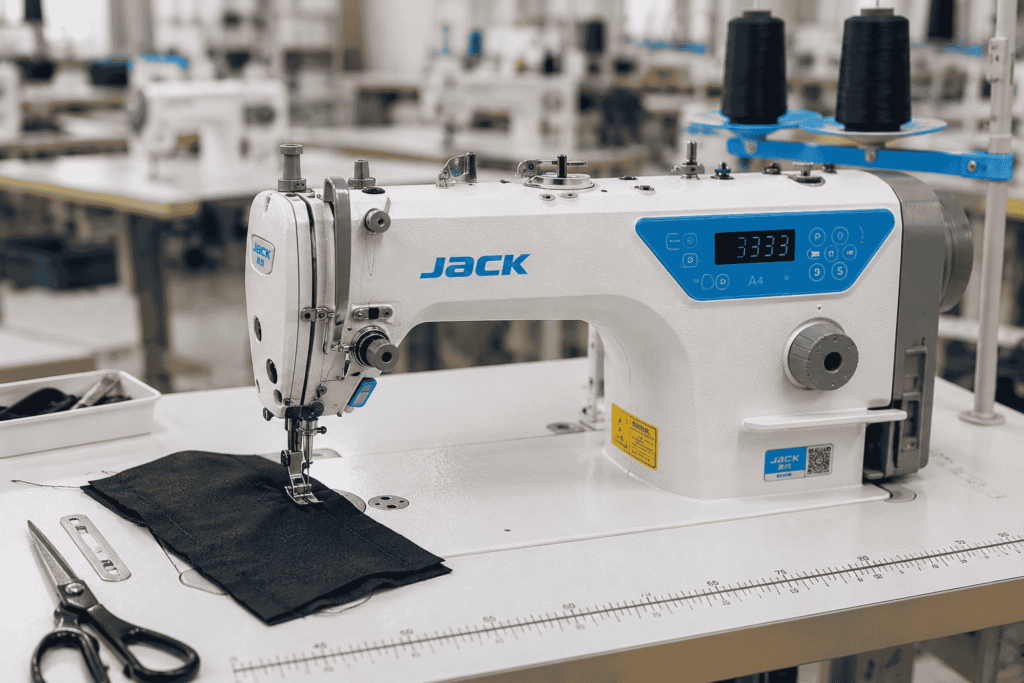
Of all the machines that a garment unit requires, the one-needle lockstitch machine would be indispensable.
The one-needle lockstitch machine is mostly utilized for straight sewing on shirts, trousers, kurtas, dresses, school uniforms, and several other garments. This machine can rightly be referred to as the backbone of garment production.
There are different types of these machines in popular brands such as Juki, Jack, Brother, and Pegasus, among others.
Why people prefer it:
- High stitching speed
- Clean finishing
- Easy for operators to learn
- Works on most fabrics
One limitation:
It only performs straight stitching, so additional machines are needed for finishing operations.
For small businesses starting garment production, this is usually the first industrial machine worth investing in.
Overlock Machine – Essential for Clean Finishing
You can immediately identify a professionally stitched garment by looking at the inside finishing. That neat edge finish usually comes from an overlock machine.
Overlock machines trim and stitch fabric edges together at the same time. They prevent fabric fraying and give garments a polished look.
These machines are heavily used in:
- T-shirt manufacturing
- Sportswear production
- Knit garments
- Stretch fabric stitching
Factories producing hosiery products often depend on overlock machines throughout the day.
Advantages:
- Fast edge finishing
- Strong seam quality
- Saves time in production
Disadvantage:
Not suitable for decorative stitching or general sewing work.
If you work with knit fabrics regularly, this machine is almost non-negotiable.
Flatlock Machine for Sportswear and Innerwear
Flatlock machines are used mostly in activewear, gym clothes, leggings, and undergarments.
This is because the sewing is flat, providing extra comfort to wear. This is why sportswear companies use flatlock machines, since they minimize the chances of irritation while moving around.
Most newcomers are unable to distinguish between overlock and flatlock sewing machines due to their similar appearances.
However, their usage varies greatly in production.
Flatlock machines are perfect if you prioritize comfort and elasticity.
Button Stitching and Buttonhole Machines
In large garment factories, separate machines are used for button attachment and buttonhole creation.
Doing these tasks manually takes time and often creates inconsistency. Industrial button machines improve both speed and accuracy.
These machines are especially useful in:
Shirt manufacturing
School uniform production
Formal wear factories
For small boutique businesses, these may not be necessary initially. But once production volume increases, they become valuable investments.
Computerized Sewing Machines Are Becoming Popular
Garment manufacturing units have gradually begun adopting computerized sewing machines in their production processes.
Some features of these machines include:
Automatic threading
Needle positioning
Pre-programmed stitches
Noise reduction
While they require high initial investment, they can be more efficient and cause less strain on workers in the long run.
The owners of factories that adopted such sewing machines reported fewer mistakes while sewing and increased efficiency in their production processes.
However, for extremely small scale operations, manual industrial sewing machines may still be used due to lower maintenance costs.
Things to Check Before Buying an Industrial Sewing Machine
Another mistake that many purchasers make is that they purchase machinery without taking into account their production requirements.
Before you purchase, think about the following:
What kinds of clothing will you manufacture?
Are you going to use woven or knit materials?
How many hours would the machine run per day?
Are spare parts easily available in your locality?
Is operator training available?
For instance, machinery which works great for manufacturing denim jeans may not be suitable for thin materials.
Likewise, there are some fast machines which suit factory-level production but are too rough for boutique-level operations.
Don’t Ignore After-Sales Service
In clothing production, time loss through machines directly influences production timelines.
The most reliable machines may cause issues due to lack of proper services. It is therefore advisable to do the following prior to purchase:
- Availability of spare parts
- Availability of technicians
- Provision of warranties
- Availability of good dealers
Professional factory owners will always choose easy service, regardless of whether it is expensive or cheap.
Final Thoughts
Not only are industrial sewing machines tools of work, they impact quality, productivity, and customer satisfaction. Making an appropriate choice should be based on needs assessment and not on the latest fad.
Rather than opting for the costly machine, consider the features like durability, compatibility with fabric, easy maintenance, and long-term usability. The selected machine can continue to benefit a garment business for years to come.
Garment makers who are searching for a reliable brand of industrial sewing machines and some valuable advice regarding the same should consider the renowned company named Narula Sewing Impex.
FAQs
Which industrial sewing machine is best for garment manufacturing?
A single-needle lockstitch machine is usually considered the most essential machine for garment manufacturing because it handles basic stitching work for many garment types.
What is the difference between an overlock and flatlock machine?
An overlock machine is mainly used for edge finishing, while a flatlock machine creates flat seams commonly used in sportswear and stretch garments.
Are computerized sewing machines worth buying?
For medium and large garment factories, computerized machines can improve speed, reduce operator fatigue, and provide consistent stitching quality.
Which sewing machine is good for beginners starting a boutique?
A single needle lockstitch machine combined with an overlock machine is usually enough for beginners handling small-scale garment production.
How long do industrial sewing machines last?
With proper maintenance and regular servicing, industrial sewing machines can last for many years, even under daily production use.